
Music, Unpacked
A Low-Pass Filter Changes Brightness Without Rewriting the Melody
Hear a low-pass filter as a change in a sound’s frequency balance, using a short melody and matched listening levels.
Clear explanations of musical ideas, with room to try them for yourself.
Hear a low-pass filter as a change in a sound’s frequency balance, using a short melody and matched listening levels.
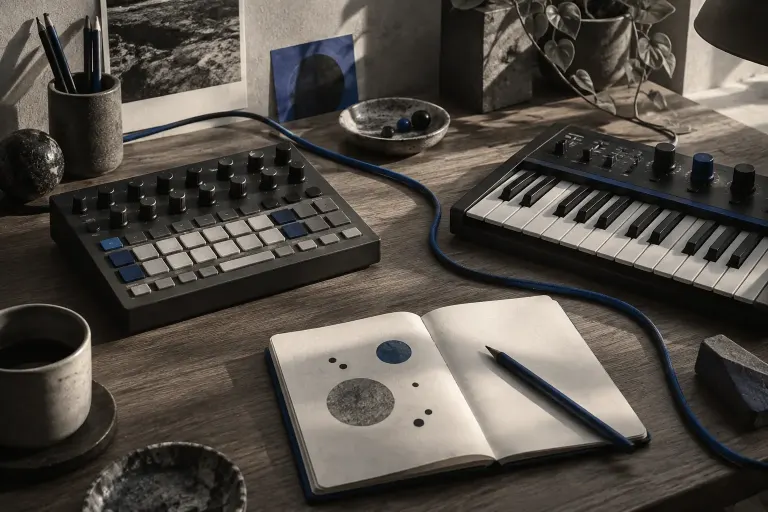
Pressing a key does not tell the whole story of a synthesised note. The sound may rise slowly, settle to another level and continue fading after your finger…
Keep a slow, comfortable pulse with one hand. Between each pair of taps, try saying two evenly spaced syllables, then three. The pulse can stay steady while…
Two people making sounds together can quickly produce a crowded texture. A simple agreement—leave some openings unanswered—creates another possibility for a…
An echo waits for a sound and answers it. A round adds another possibility: the second person begins the same phrase later while the first person continues.…
Compare the same pair of pitches played together and one after another to hear the distinction between harmonic and melodic intervals.
Try a simple C-major chord in different inversions and listen to how the lowest note changes the arrangement without introducing a new pitch class.
Try a quiet tapping exercise that separates a gradually changing pulse from a change in loudness, then describe where keeping them apart becomes difficult.