
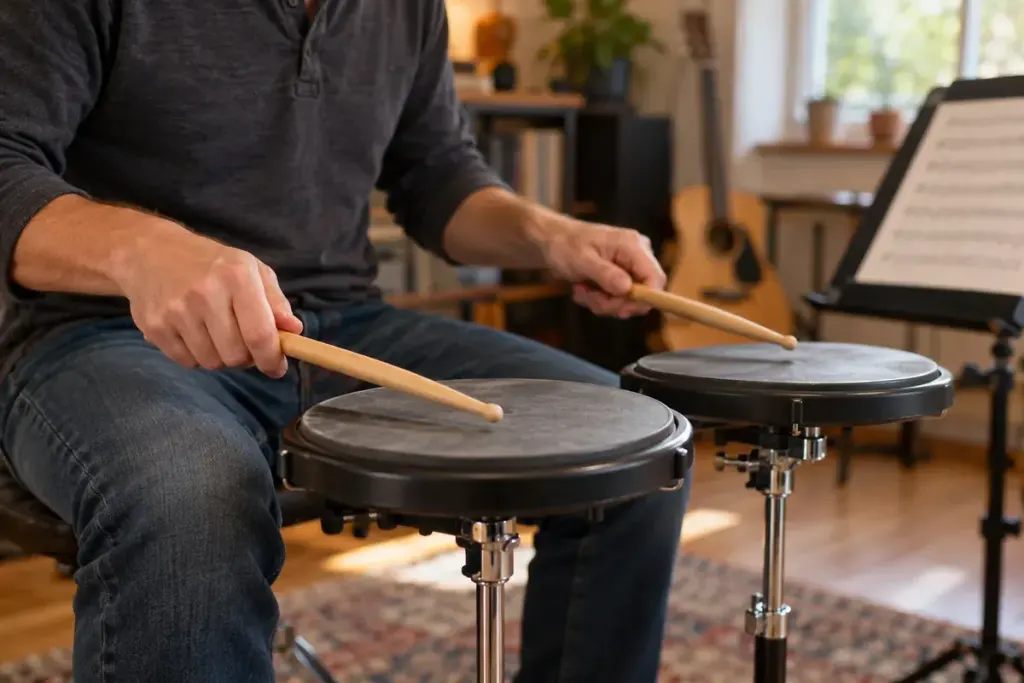
Two notes can fit between the same pair of beats without dividing the space equally. That small timing change is a useful way into listening for swing, provided the underlying beat does not wander with it.
Keep one hand steady
Tap a comfortable, unhurried pulse with one hand. With the other, tap twice during each beat, initially making the two gaps equal. Now delay the second tap slightly while keeping the next beat in place. The first gap grows; the second shrinks.
Record a short example of each version on a phone. Do not speed up the long-short version to make it feel more energetic. If the pulse drifts, simplify to one hand and count the beat aloud between attempts.
Use the exercise as a doorway
For a software example, the MuseScore handbook describes adjustable swing playback. A long-short pair is a practice device, not a universal formula for how every musician swings. Listen to a recording and focus on one repeating part for several bars. Ask whether the timing feels even or uneven, and whether that impression changes with tempo or phrasing. Avoid measuring an entire performance from one isolated pair of notes.
For a small composition experiment, keep a four-note melody and its pitches unchanged. Make one straight version and one with your deliberately uneven subdivision. Compare the relationship between the melody and pulse, rather than voting for the better version. Write one concrete observation—perhaps that a second note seems to lean toward the next beat—so the experiment leaves something more useful than a genre label.
AI-generated editorial illustration; not a documentary photograph.