
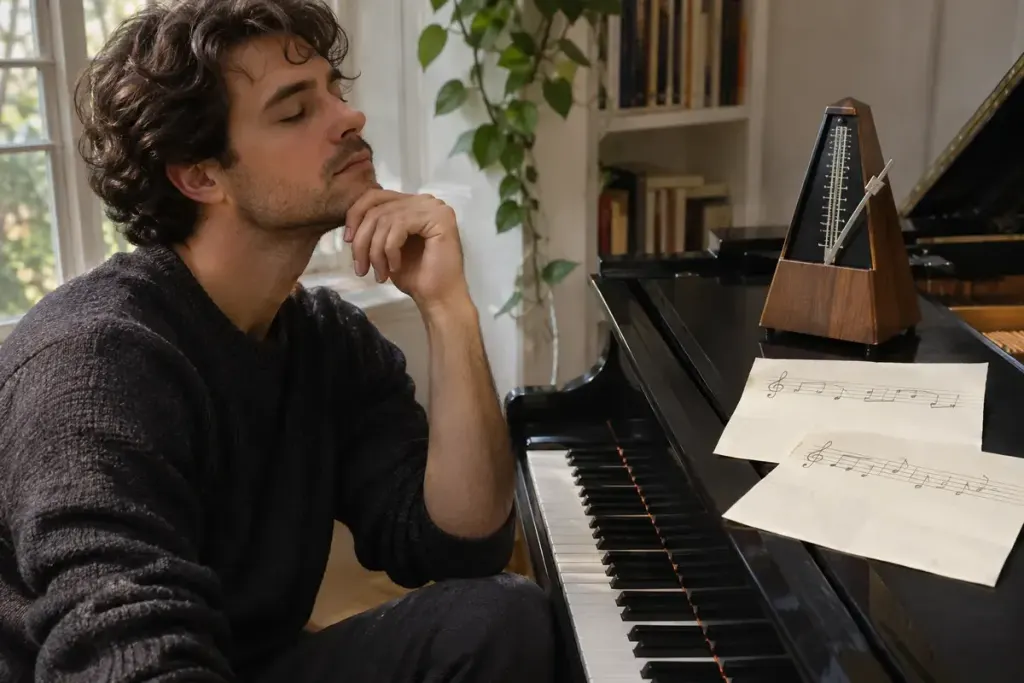
A familiar melody returns, but this time it seems to occupy a larger space. The notes arrive in the same order while their durations have grown. Instead of adding new pitches, the music has changed how much time the idea takes.
That is a useful way into rhythmic augmentation. It can make a small musical figure feel more expansive while preserving features that allow a listener to recognise it.
Stretch the note values, not the pulse
Music Theory for the 21st-Century Classroom describes augmentation as commonly doubling the duration of each rhythmic value in a motive or phrase. Diminution moves in the opposite direction by shortening the values.
For an original practice example, choose four comfortable pitches, such as C, D, E and C. Keep a slow, steady pulse. Play or hum each pitch for one beat: the little idea occupies four beats.
Now keep that pulse unchanged and give each pitch two beats. The same sequence occupies eight beats. If someone else taps the pulse throughout, it becomes easier to hear that the notes have grown relative to the continuing beat.
This is not the same experiment as slowing the entire performance so that every musical layer takes twice as long. In the exercise, the reference pulse stays available while one idea changes its durations.
Find what still makes it recognisable
After trying the two versions, ask what connects them. The pitch order and rising-then-returning contour remain; the spacing of the attacks changes. You can notice both continuity and difference without needing a finished composition.
For a second experiment, keep the final note longer than the others in the original pattern, then double all of those values in the new version. Preserve the proportional relationship. Otherwise you may be changing the rhythm in another interesting way, but no longer testing the same simple transformation.
When listening to a recording, avoid labelling every broad phrase as augmentation. Look for a recognisable earlier idea and compare the written or audible durations against a continuing pulse. A score, when available, can help test your impression.
Even when the technical label remains uncertain, the listening question is worthwhile: what stayed recognisable while the musical idea took more time? It draws attention to development that happens through rhythm rather than through a new tune.