
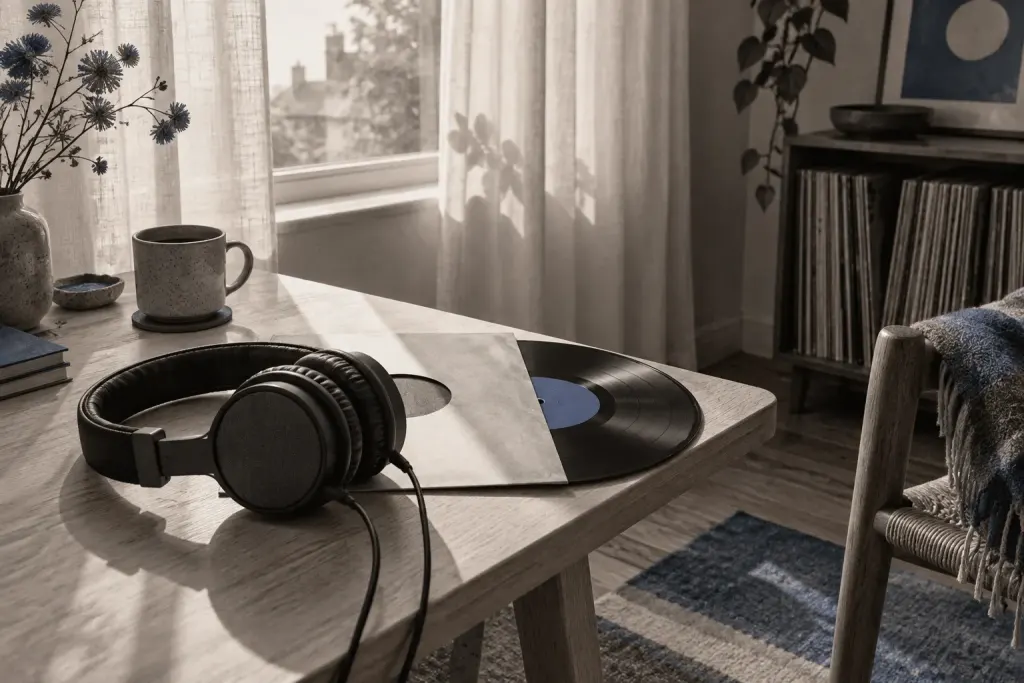
You know when the chorus arrives. You can anticipate the final line. Yet the little sound beneath the second verse may have escaped you for years. Familiarity makes a song comfortable; it can also make your attention settle into the same route every time.
Try choosing one recording you already enjoy and one small question. You do not need to identify every instrument or turn an evening with music into homework. The point is to give your ears somewhere new to go.
Pick a sound that usually stays at the edge
A bass note, a brushed rhythm or a distant backing voice can be a useful guide. Follow that part for a short passage. Does it repeat exactly? Does it leave a gap when the singer enters? If you lose track of it, that is useful information too: another sound has pulled your attention away.
Ableton’s guide to active listening describes concentrating on individual musical layers. Treat that as an invitation, not a test with a correct answer. You can describe what you hear in ordinary words: a dry tap, a wavering hum, a voice that seems close.
Write a moment, not a review
Here is an invented notebook entry: At about one minute, the low part disappears and the room seems bigger. It is more useful for this exercise than deciding that the production is good or bad. It gives you a moment to revisit and a change to listen for.
On the next pass, ask whether the impression comes from that missing part, from something else entering, or from both. Your first explanation may change. Listening closely does not require being certain.
Compare the beginning and the return
When an earlier section comes back, listen for one difference. Perhaps the vocal doubles, a sustained sound sits underneath, or the rhythm becomes less busy. Perhaps nothing obvious changes, but the intervening section makes the return feel different. Both are worth noticing.
Keep your notes brief enough that you can still enjoy the track. Three observations about a single song are plenty. Save the exercise for another day if it starts to feel like a chore.
Leave room for enjoyment
There is no obligation to analyse everything you love. Sometimes the most useful result is simply wanting to hear the song again. If a rhythm catches your attention, our guide to beat, tempo and rhythm gives you a few words for that experience. If a texture catches it instead, try looking for sounds in ordinary objects.