
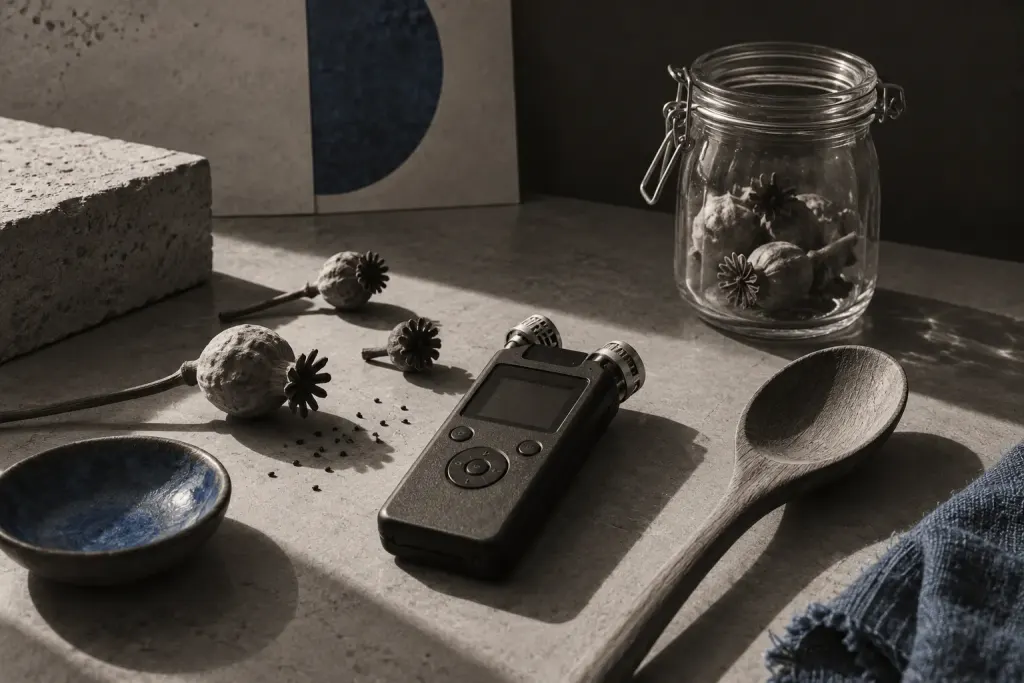
A spoon touching a jar makes a brief, bright sound. A fingertip against a cardboard box gives you something softer. Before you buy another instrument or browse another sample pack, there is a small collection of possibilities on the table.
This exercise is deliberately modest: find three objects, record a few short sounds and arrange a phrase. Use objects you can handle safely, work in your own space and avoid recording other people’s conversations.
Choose sounds with different shapes
Look for contrast rather than novelty. One object might make a short click; another might rustle for longer; a third might ring and fade. Those differences give you something to arrange even when the objects themselves are unremarkable.
Ableton’s found-sound recording lesson treats everyday sounds as musical material and includes phones among the possible recording devices. You can begin with what you already have. This is an experiment in attention, not a comparison of microphones.
Change one thing before changing everything
Make a sound gently, then try a slightly different contact point. Tap the middle of an empty box and then its edge. Keep your recording position roughly the same so that you can compare the two. Listen back before collecting more.
Do not chase a perfect take for half an hour. A short recording with a clear beginning and ending is enough to explore. If handling noise overwhelms the object, put the recording device on a stable surface and try again. Check the playback at a comfortable level.
Give each file a useful name
Imagine returning to twenty files called Recording 1, Recording 2 and Recording 3. A few extra words now save a guessing game later. An illustrative name such as box-edge-soft-01 tells you the object, the action and which take it was.
Keep a tiny note beside the files: what made the sound, where you recorded it and what you might try next. You are building a collection you can understand, not a library that must impress anyone.
Make a phrase that leaves a gap
In an audio editor you already use, place a click, a rustle and another click on a timeline. Listen. Move the rustle later, or remove the second click. The gap can matter as much as the objects. Save two versions and decide which makes you curious enough to continue.
No particular software or finished track is required. For another way into arranging, explore the difference between a steady pulse and the pattern around it. To sharpen your ear first, spend a few minutes with a familiar recording.